Free Inquiry #2 Echo Chambers in Online Peer-Based Learning
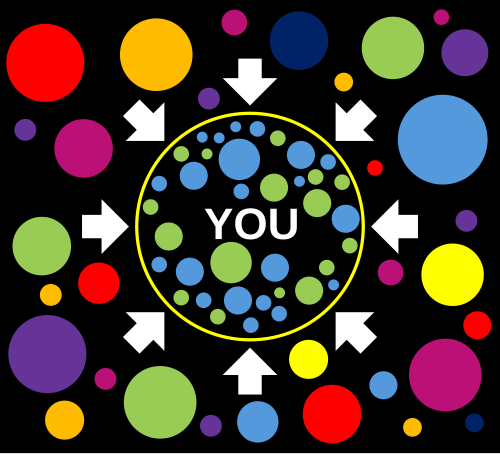
Licensed under CC BY-SA 4.0 — https://creativecommons.org/licenses/by-sa/4.0/
Source: Wikimedia Commons — https://commons.wikimedia.org/wiki/File:FilterBubble.svg

1. Introduction
I shared two guiding questions in the previous post. For this post, I want to focus on the first question:
Can online peer-based learning communities become echo chambers?
2. Technological Aspect of Echo Chamber
The video explains how platforms like Facebook and Google filter information using algorithms, showing users what they are most likely to agree with. I didn’t realize how much these platforms control what we get to see and what we don’t get to see.
If this kind of filtering already shapes what we see online in everyday life, it’s not surprising that something similar could happen inside online peer-based learning communities too. If learners mostly interact with posts that match their own opinions, unpopular perspectives might slowly disappear from discussions in the same way.
The video also points out that social media can hide certain viewpoints from users without them realizing it. If most learners in a discussion agree with one viewpoint, there is a chance that other opinions could be ignored or pushed away, even without anyone doing it on purpose. In that situation, learners with different ideas might feel uncomfortable sharing their thoughts.
3. Social Dynamics Behind Echo Chambers
Echo chambers are not only driven by technological filtering, but also by social dynamics within peer groups. Research suggests that the development of echo chambers can be influenced by several social factors (Chakraborty, 2023). In particular, several interpersonal and psychological factors reinforce conformity in group-based communication:
- Desire for acceptance and belonging — people conform in order to be accepted by the group.
- Fear of rejection or isolation — holding a different opinion may lead to the fear of being excluded.
- Peer pressure / normative social influence — implicit group norms encourage conformity.
- Group identification — strong identification with the group increases the likelihood of adopting majority views.
- Reinforcement hypothesis — conformity is rewarded through social approval and psychological satisfaction.
Even without explicit censorship or algorithmic filtering, social incentives alone can suppress minority or unpopular perspectives.
This suggests that echo chamber effects may happen in any peer-based community, including educational settings, when learners feel that deviating from the group norm has social costs.
4. Echo Chambers in Online Learning
Peer-driven conformity can become particularly visible in online learning (Tkácová, 2025). digital platforms can unintentionally promote similarity of viewpoints when students mostly interact with like-minded peers.
The persistence of echo chambers in online learning can be explained by several structural features of the online environment:
- Limited spontaneous clarification — fewer chances to ask follow-up questions or check meaning in real time
- Reduced critical questioning — disagreement is less likely to occur naturally compared to face-to-face learning
- Lack of informal correction — misinformation can circulate without immediate challenge
- Social validation loops — agreement from peers replaces evidence as the basis of credibility
As a result, echo chambers in online learning tend to:
- decrease cognitive diversity,
- suppress minority or unpopular viewpoints, and
- reduce the educational value of collaborative learning by limiting exposure to alternative interpretations
These patterns highlight that the challenge in online learning is not merely the availability of information, but whether learners feel socially safe to express disagreement.
5. Summary
Even though the technological aspect is not specifically about online learning or education itself, I felt it was important to mention because many people get information from the internet. When I combine this with the social factors and online conditions I looked at, I can see how echo chambers might become stronger in peer learning communities. For my next step, I would like to turn to my second guiding question.
I used ChatGPT to help with wording and organization in this post
References
Chakraborty, A. (2023). Social conformity among peer groups in educational institutions.
International Journal of Innovation and Multidisciplinary Research, 3(2), 41–48.
https://ijiamr.cmrie.org/docs/social-conformity-among-peer-groups-in-educational-institutions-DQTTFFWDKEKL.pdf
Tkácová, H. (2025). Challenges of misinformation in online learning: A post-pandemic perspective.
Encyclopedia, 5(1), 25. https://doi.org/10.3390/encyclopedia5010025